Innovative Service
A better day at the workshop.
My role
Product design and engineering for the current Next.js rebuild of the original Haspr team project. Source and software updates stay with our team.
Project status
Phase 0 local test stage complete. Staff and production acceptance remain open; Phase 1 productization is planned.
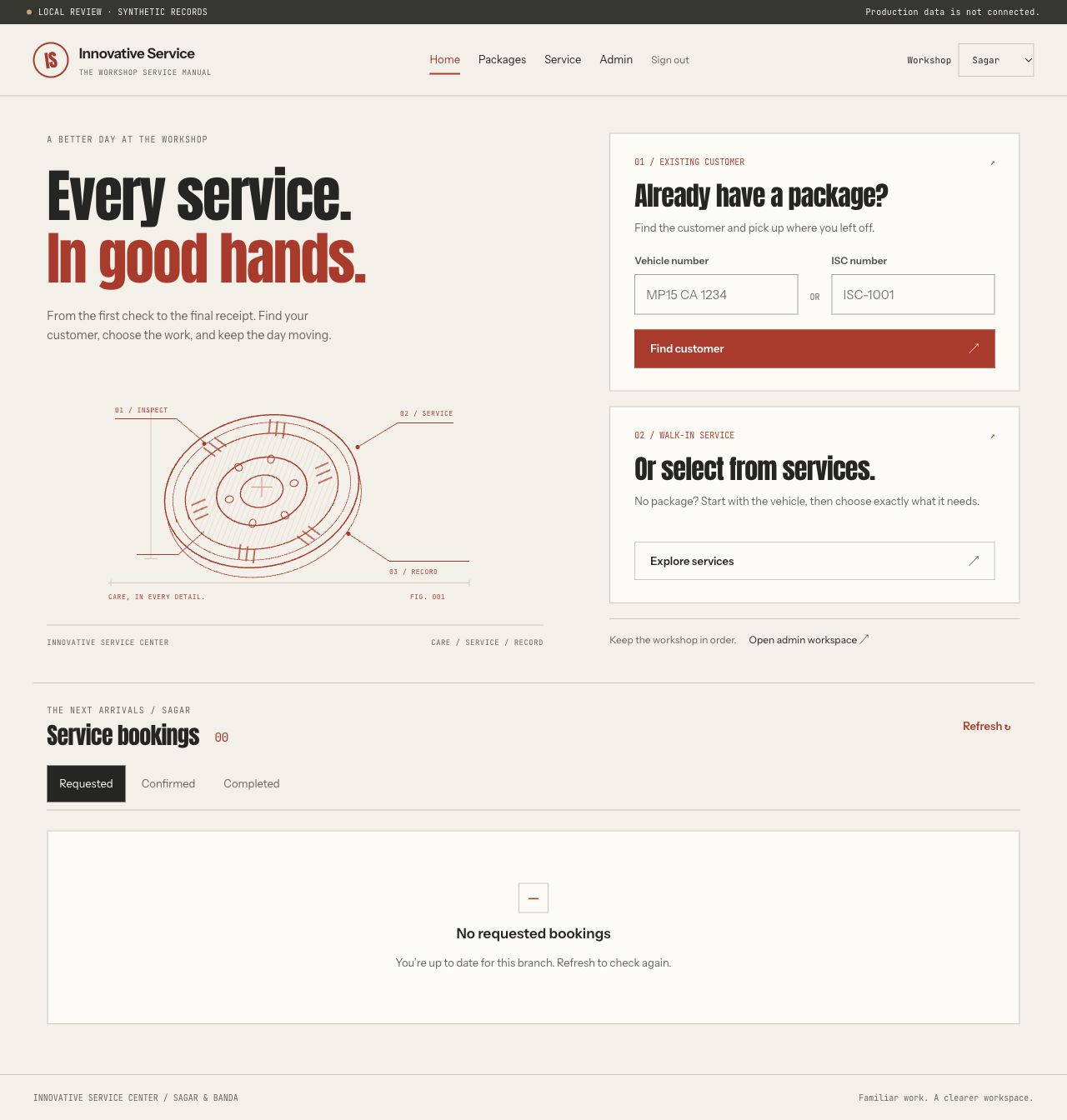
The idea behind the work.
Innovative Service started as a Haspr team project for garage operations. I returned to it in 2026 to rebuild the workspace around the tasks that make up a workshop day: find a customer or vehicle, check service-package coverage, prepare a bill, update branch stock and recover the saved receipt. The new Service Manual design uses the language of a workshop: warm paper, red annotations, clear task choices and practical forms. Next.js, React and TypeScript provide the new application foundation, with server-owned commands and a Firebase emulator adapter for local verification. Phase 0 concentrates on the original garage and compatibility with its existing records. The next product direction is to make that foundation reusable for other garages, while keeping software maintenance with our team.
What I chose.
And why.
Rebuilding an existing garage application means preserving what staff already understand while making billing, stock and customer history reliable. A retry must not create a second charge or stock issue, and missing historical data must stay visible rather than become an invented value.
Retain the seven familiar routes and organize them around customer lookup, service packages, walk-in billing, administration, employee operations, receipts and GST detail.
Use server-reviewed commands, exact-paise calculations and durable operation identities so interrupted billing can recover the same committed result.
Keep branch stock, vehicle entitlements and saved receipt snapshots explicit; preserve unknown historical fields and apply staff permissions to the action being performed.
Verify with isolated synthetic records and local Firebase Auth, Firestore and Storage emulators before connecting the original garage to the rebuild.
Closer to the source.
Dates and capture context are preserved for every image.

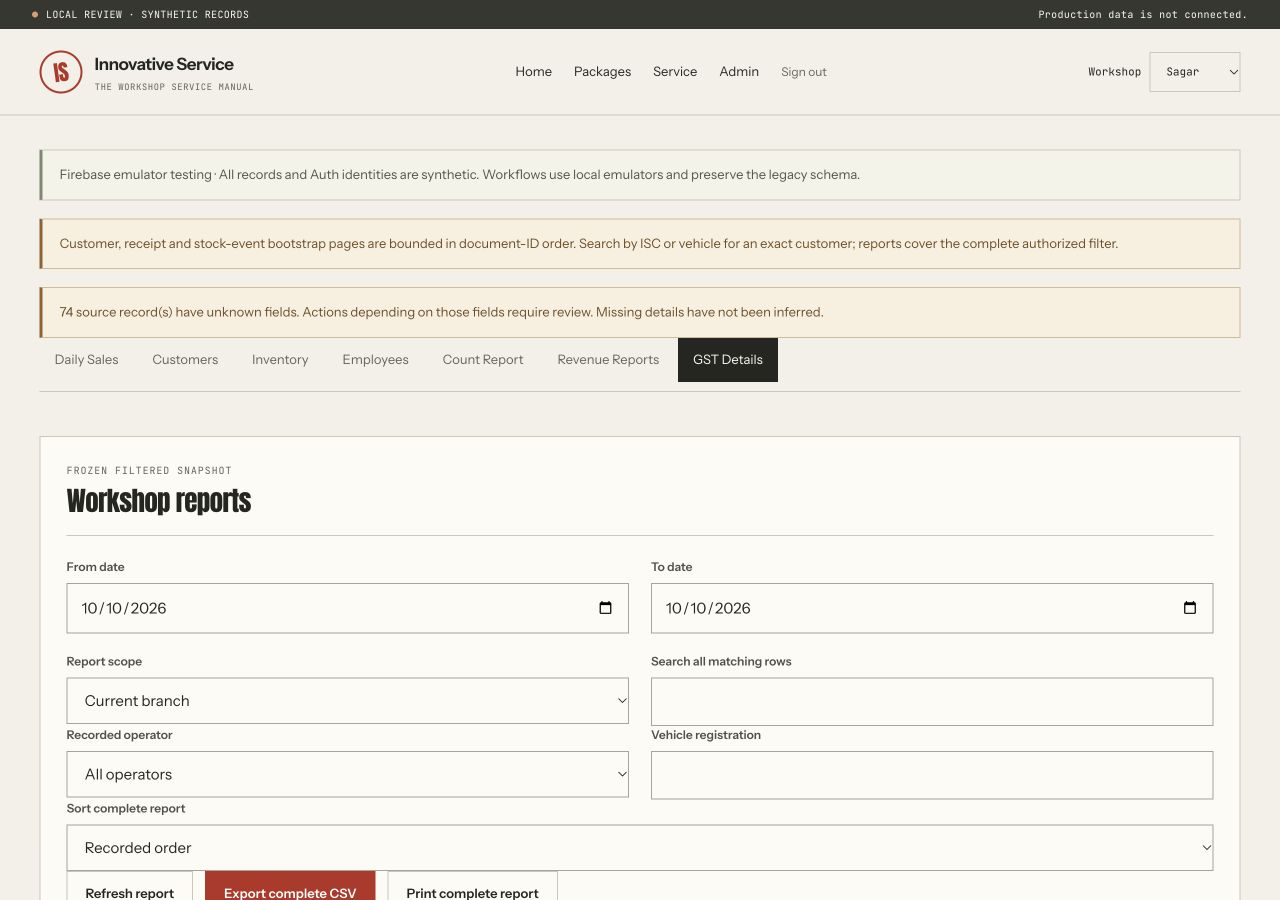
What the work shows.
The recorded 10 October Phase 0 checkpoint passed 253 unit tests, 73 emulator tests, 116 Firebase HTTP checks and 16 synthetic HTTP checks, alongside typecheck, lint and a production build. Local browser rehearsals covered purchase, service and renewal independence, saved receipt recovery, collected-funds approval and consistent report exports. The screenshots show the actual application in synthetic review; these results establish the local test stage.
Where I keep the distinction.
Staff rehearsal, native devices, physical printers and scanners, and production activation still need acceptance. The hosted staff shell has business access disabled. The source is private, and only our team maintains software updates. Reuse across other garages is a Phase 1 plan; garage onboarding and production data isolation have not shipped.
What comes next.
- Phase 0 / Local test stage complete
Rebuild for the original workshop.
Restore the familiar garage workflows on the new application foundation, preserve legacy records and verify billing, stock, entitlements and recovery locally. Staff rehearsal and production acceptance are the next gates.
- Phase 1 / Planned
Make it reusable for other garages.
Turn the verified foundation into a configurable product that can be distributed to other garages. Plan repeatable setup, garage-specific branding and service catalogues, independent records and permissions, and releases maintained by our team. Garage staff would manage their daily operations; software updates would remain with us.